

Three Science Takeaways From a Long, Hilly Race
Plus mental warmups, the Dark Room problem, and more

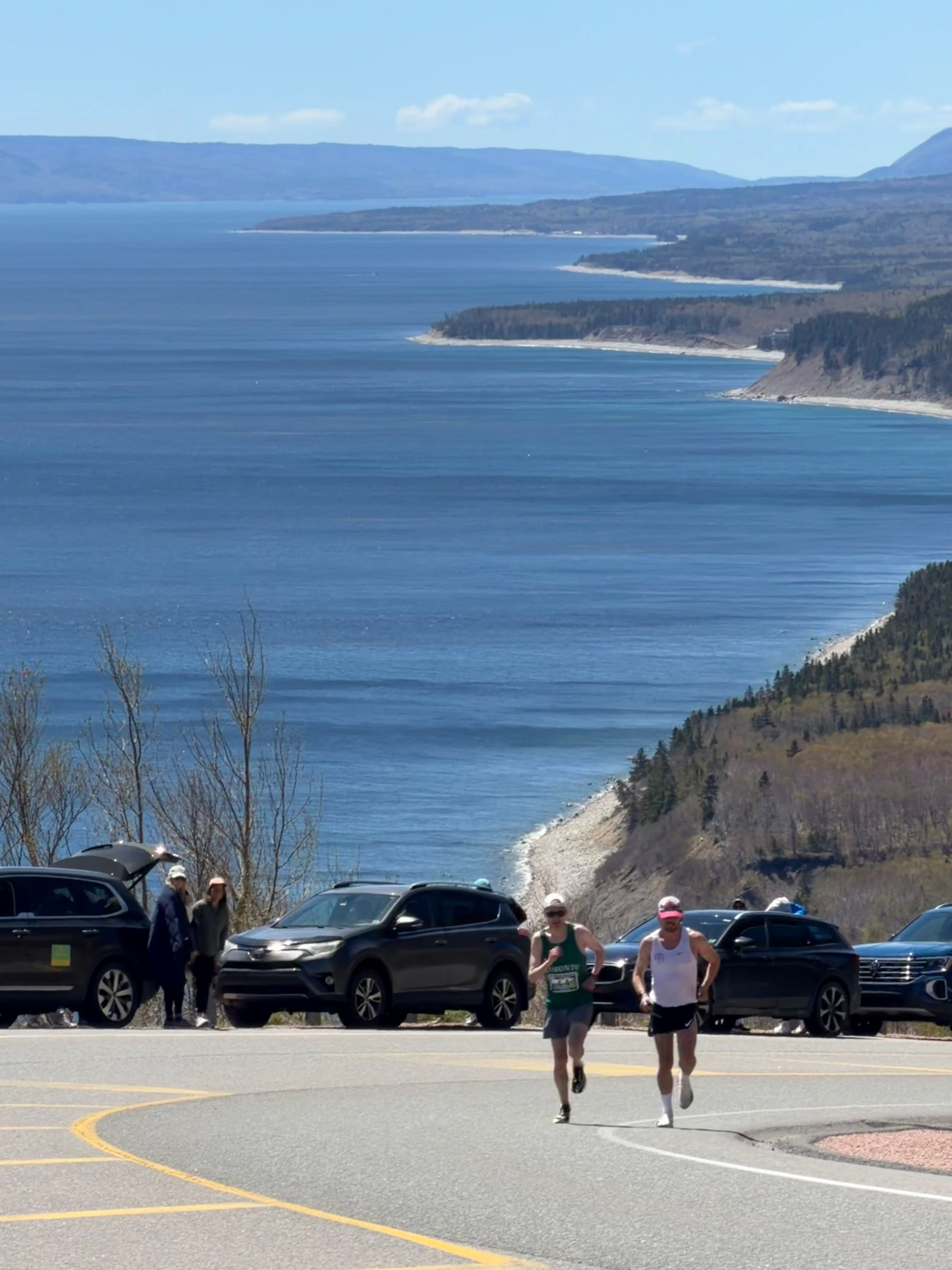
A few weeks ago, I ran a race that has true “cult classic” status in Canadian running circles: the Cabot Trail Relay. It’s 276 kilometres around the unbelievably scenic perimeter of Cape Breton, on Canada’s east coast, divided into 17 punishing legs that run through the night and into the next morning. And it’s very different from most of the races I’ve been running in recent years (i.e. 5Ks, 5 milers, and cross-country). I came away with three science-of-running reflections:
Ease off the ups, push the downs
There’s a study from back in 2010 that has really stuck with me. It used a portable VO2 analyzer on runners running a hilly 10K course, to figure out when they were pushing harder than average and when they were going easier. The results: they consumed more oxygen (and thus energy) on the uphills, and less on the downhills. Seems obvious, right?
But in a perfect world, that’s not how you would pace yourself. You would slow down enough on the uphills to keep your VO2 roughly constant, and speed up enough on the downhills to do the same. Instead, our “constant speed” bias overrules our desire for constant effort.
My leg at Cabot was 20K long with a big climb ascending around 300 metres over the course of 3 or 4 kilometres, then descending the same amount over a slightly longer distance. Before the race, I reminded myself of the easy-up, hard-down plan. And I’m happy to say that I executed it pretty well. I’m generally a strong climber, so my mantra on the way up was “Don’t pass that guy in front of me! Don’t pass him!” This required dialing back, so I reached the top feeling good, and was able to attack the long descent. That went pretty well too… until the final mile, when the pounding finally became too much for my legs and I lost about a minute on the runners around me. All in all, though, I think I got the most out of myself with this approach.
Cushion the blow
I’m not a supershoe denier (far from it!). They definitely work. But even though I’ve written a lot about them, I mostly haven’t run in them other than a review pair of the OG Vaporfly that I got from Runner’s World back in 2017. Most of my running goals these days are internally driven, so I’m not all that interested in getting a few percent faster with no effort.
Two things were different about this race. One is that I was part of a relay team with competitive aspirations in the masters division, so saying “I don’t really care about times” would be pretty selfish of me. The other is that I was initially slated to run two legs of the relay. I eventually weaselled out of this fate, but at first I was very concerned about the challenge of running back-to-back hilly ten-milers with only a half-day of rest in between. As a relatively low-mileage runner, I figured I needed all the recovery aid I could get, and there is indeed some preliminary (albeit Nike-funded) research suggesting that cushioned supershoes reduce muscle damage—so I ordered some billowy new kicks.
In the end, I only ran one leg—but it did have that punishing half-hour continuous descent from Cape Smokey. I’ve had some crippling muscle soreness after mountain races with long descents. This time I felt surprisingly good in the aftermath. Not great. A full week later, when I tried to run for an hour, my quads gave out after 45 minutes. But overall I think it was worth the money.
Social energetics
The team I was running with is affiliated with the Toronto Harriers, a group in my home city. I knew a few of the guys beforehand, and had seen most of their names in local race results over the years, but they were mostly new to me. By the end of the weekend—including something like 28 hours hopping in and out of vans—they were like brothers to me. That’s how these things go. And it’s actually a big part of the reason we do it, I think.
I’ve got an article in the upcoming Summer print issue of Outside on a concept that has recently been dubbed “social energetics,” which describes the changes in how we allocate energy in presence of others. One of the scientists I spoke to was Emma Cohen, an evolutionary anthropologist formerly at Oxford University. My first encounter with her research was a 2009 study in which she showed that Oxford rowers had increased pain tolerance after a workout—but that the increase was twice as big when they worked out with their teammates compared to when they did it alone.
Running is often thought of as a solitary sport, as are other endurance sports. And it can be. But it can also be a medium of incredible bonding. I’ve always loved relay races, team-scored cross-country, and other contests where social energetics are at the fore. I’m pretty confident that I dug way deeper on the Cabot Trail than I could have in any standard solo race. (That said, my Harriers team was roundly defeated—you might even say sucker-punched—by a super impressive masters team from Cape Breton Road Runners. Chapeau, guys!)
Other stuff
For Outside, I wrote about a study claiming that warming up your brain with three-minute cognitive tasks on a smartphone can improve mile run time by a couple percent. I’m cautious about what those results really mean, but I think they might be telling us something important about what a warmup is really for.
I also wrote about a study suggesting that women have better “fatigue resistance” than men—that is, that traits like VO2max and running economy change less with fatigue. I figured the study was timely given the excitement around Rachel Entrekin’s recent overall triumph at the Cocodona 250. I’m not convinced Entrekin’s main edge is physiological, but it’s food for thought.
Quick service note: the Outside articles above are behind a paywall. The exact nature of that paywall changes as they explore different models; sometimes there are free articles available to non-subscribers, other times there aren’t. I genuinely wish all articles could be available for free, but Outside—like many publications these days—is trying its best to find a way to be financially viable. For what it’s worth, I think $60 a year for full access to Outside and its ten sister publications (including RUN, Backpacker, Velo, and more) is a great deal! I write four Sweat Science columns every month for them, and that regular gig has been the anchor of my writing career.
Finally, I had a lot of fun writing this essay for Big Think about why play brings us pleasure. It frames play in the context of brain science’s big new “theory of everything,” predictive processing, and ponders the “Dark Room” problem: if our brains seek to predict the world with maximum accuracy, why don’t we just lock ourselves in the closet instead of venturing out to play in the unpredictable world? The essay draws on ideas I dug into in my recent book, The Explorer’s Gene (which, of course, I hope you’ll check out—especially since it’s currently 51 percent off on Amazon.com!).
Many thanks for reading,
Alex Hutchinson
I love downhill running and that approach has always worked well for me! I also love long-distance relays like The Wild West Relay from Ft. Collins, Colorado to Steamboat.
I ran that leg in 2010. Legend.